
Traded for a Fence
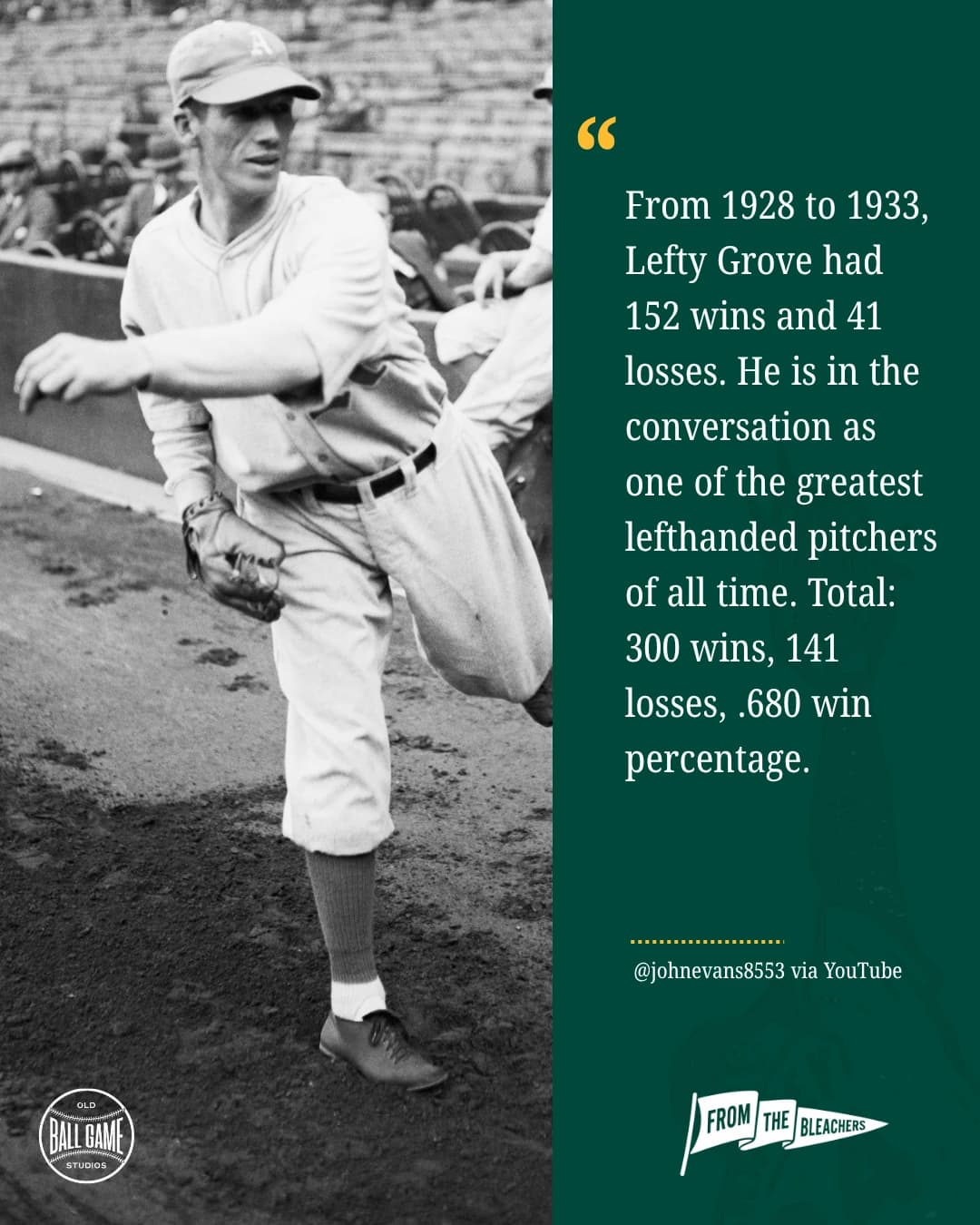
This story was left in our comments by
@johnevans8553, via YouTube
He was traded for a fence.
In 1920 a storm knocked down the outfield wall at the ballpark in Martinsburg, West Virginia. Jack Dunn, who owned the minor league Baltimore Orioles and had already discovered Babe Ruth, offered to pay for a new one in exchange for a 20-year-old left-hander who had learned to throw by firing rocks. Grove spent the rest of his life saying he was the only player ever traded for a fence.
★ For the record ★
46-4
July 1930 through September 1931 — the best fifty-game stretch any pitcher has thrown
Then Dunn kept him. For five years. Baltimore wasn't affiliated with any major league club and Dunn didn't have to sell to anybody, so Grove went 108-36 in the International League and struck out 1,108 batters while the majors waited. Connie Mack finally bought his contract after the 1924 season for $100,600. Six hundred dollars more than the Yankees paid for Ruth, which was reportedly the whole point of the figure.
Grove didn't throw a major league pitch until he was 25. He went 10-12 as a rookie and the papers took to calling him the hundred-thousand-dollar lemon.
Then it started. Nine ERA titles, more than any pitcher in history has led a league. Seven consecutive strikeout crowns to open his career. From July 1930 through September 1931 he went 46-4, which researcher Jim Kaplan identified as the best fifty-game stretch any pitcher has ever thrown. Three hundred wins, all of them after age 25.
And in October 1929, right in the middle of that, Mack looked at a Cubs lineup that hit right-handed almost top to bottom and handed the World Series opener to a 35-year-old righty with a sore arm who had pitched 54 innings all season. Howard Ehmke struck out 13 and set a Series record that lasted until 1953. Mack was right. Grove worked out of the bullpen instead: 6.1 innings, no runs, ten strikeouts, two saves.
Being the best pitcher alive doesn't guarantee you the ball.