
The Mule Kicks the Maestro
A slugger who made a Hall of Famer pay, a broadcast nobody could watch, a swamp dug before dawn, and baseball's unluckiest arm.
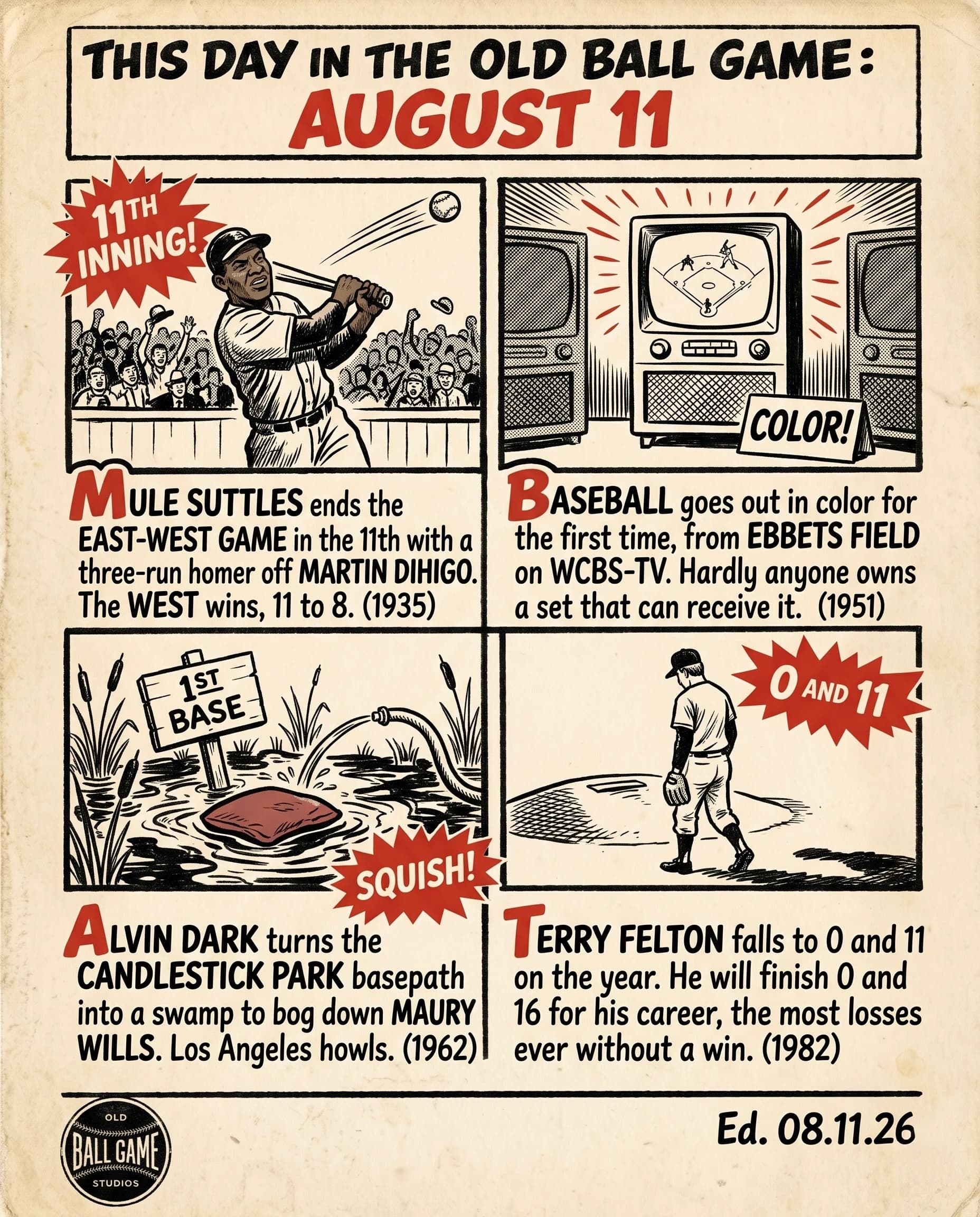
Ed. 08.11.26
The Mule Kicks the Maestro (1935)
The East-West Game was the Negro Leagues' showcase, and the 1935 edition at Comiskey Park was its wildest. Tied after nine, both teams scored four in the tenth. In the bottom of the eleventh, two out and two on, the East brought in Martin Dihigo, a center fielder who was also one of the great pitchers alive, and walked Josh Gibson to get to Mule Suttles. Suttles hit the next good pitch out of the park. West 11, East 8, and two future Hall of Famers settled it between them in about four seconds.
Color Arrives, Nobody Can Watch (1951)
WCBS-TV put a Dodgers and Braves doubleheader from Ebbets Field on the air in color, the first time a big league game had been broadcast that way. One problem. CBS used a field-sequential system that ordinary black-and-white sets could not receive at all, and CBS had not yet put a color set on a store shelf. More than ten million American sets were simply blind to it. Ten weeks later CBS abandoned color entirely.
The Swamp Fox of Candlestick (1962)
Maury Wills was running toward a then-record 104 steals, and Giants manager Alvin Dark decided the answer was drainage. Before dawn on the day Los Angeles arrived, groundskeeper Matty Schwab and his son dug out the dirt where Wills took his lead and replaced it with sand, peat moss, and water, then smoothed an inch of soil over the top. The umpires poured sand on the bog, which produced more bog. San Francisco swept all three. Dark spent decades blaming a broken hose.
Zero and Eleven (1982)
The Angels beat the Twins 6 to 3, and Terry Felton fell to 0 and 11. He was 24, he held the Toledo Mud Hens career wins record, and Brooks Robinson kept insisting the kid was better than his line. The line won. Felton finished the year 0 and 13, never pitched in the majors again, and still owns the record for the most career losses without a victory at 0 and 16. Some careers are less a story than a weather pattern.