
The First All-Star Game Was a Fundraiser
A funeral that turned into a celebration, a record set under the lights, a pitcher who beat himself, and a rulebook that finally lost an argument.
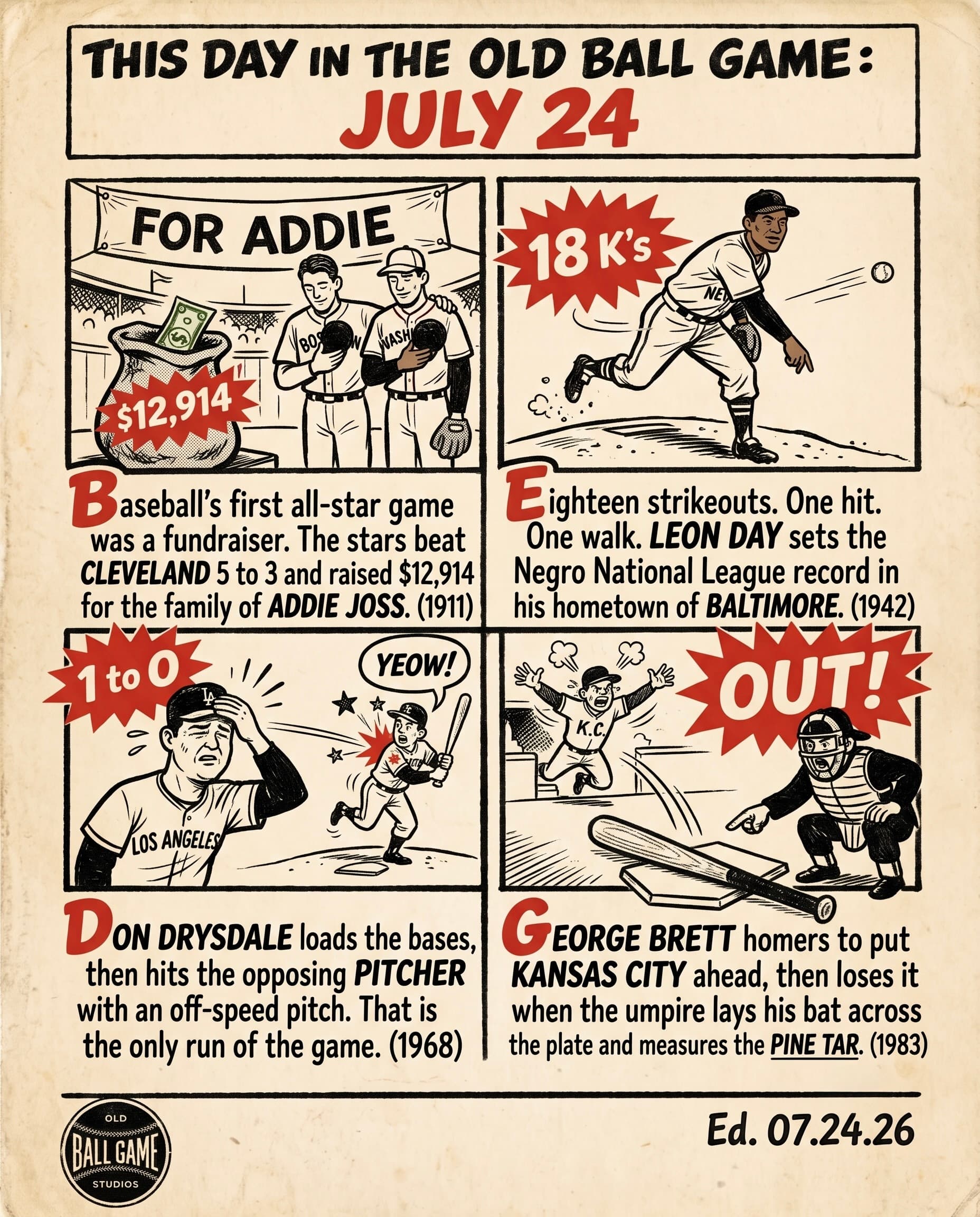
Ed. 07.24.26
The First All-Star Game Was a Fundraiser (1911)
Addie Joss died that April at 31. The league sent its best players to Cleveland's League Park on an open Monday to play the Naps for his widow and two children. Ty Cobb's Detroit uniform never arrived, so he played in a borrowed Cleveland road jersey. The stars won 5 to 3 and raised $12,914, more than twice what Joss made in a year. The official All-Star Game was still 22 years away.
Eighteen Strikeouts in His Hometown (1942)
Leon Day was raised in Baltimore, and when the Newark Eagles came to Bugle Field he struck out 18 Elite Giants, one past the Negro National League record Satchel Paige had set. He gave up one hit, a bloop into short left, and one walk. He got 18 of the 27 outs himself. Day was drafted the next year and came ashore at Utah Beach six days after D-Day.
The Only Run Scored on a Bruise (1968)
Six weeks earlier Don Drysdale set the record with 58 and two thirds straight scoreless innings, a streak that survived only because an umpire ruled Dick Dietz never tried to dodge a bases-loaded pitch. Then the math reversed. Drysdale put two men on in the fifth, hit Ron Brand to load them, then hit Houston pitcher Don Wilson to force in a run. Astros 1, Dodgers 0. He drilled Rusty Staub in the eighth too, payback he later admitted for Staub going through his shaving kit at the All-Star Game.
The Pine Tar Game (1983)
Two outs in the ninth at Yankee Stadium, and George Brett homered off Goose Gossage to put Kansas City up 5 to 4. Billy Martin had been saving this one. He strolled out and asked to see the bat. Rookie umpire Tim McClelland laid it across home plate, 17 inches wide, saw pine tar past the 18 inches allowed, and called Brett out. Brett came out of that dugout like something fired from a cannon. Four days later AL president Lee MacPhail upheld the protest, said the call violated the spirit of the rules, and gave the homer back.