
The Glove That Swung a Pennant Race
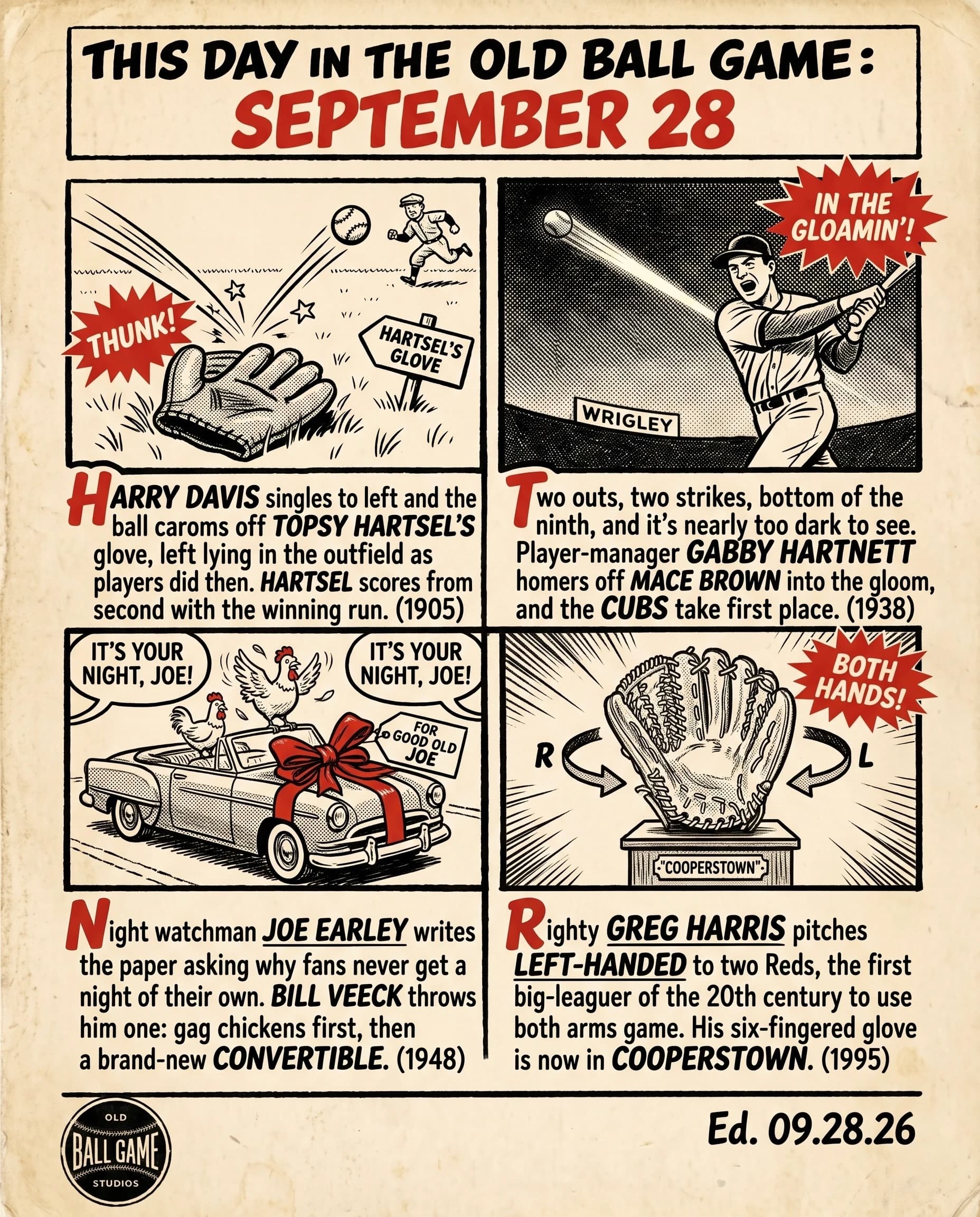
A glove nobody picked up, a swing nobody could see, a night for nobody in particular, and a glove built for either hand.
Ed. 09.28.26
The Glove That Swung a Pennant Race (1905)
Until 1954, players didn't carry their gloves to the dugout. They dropped them on the field and went in to hit. With the A's and White Sox fighting for first in Philadelphia, Harry Davis singled to left and the ball struck Topsy Hartsel's glove, lying right where he'd left it. The ball changed direction, and that little delay was enough for Hartsel to score from second with the winning run. The A's took the pennant by two games.
The Homer in the Gloamin' (1938)
Wrigley Field had no lights, and the umpires had decided the ninth would be the last inning before calling it a tie. The Cubs trailed Pittsburgh by half a game. With two outs, player-manager Gabby Hartnett fell behind Mace Brown 0-2, then hit one into the dusk that much of the crowd could barely follow. The Cubs moved into first place and went on to win the pennant.
Good Old Joe Earley Night (1948)
Joe Earley, a World War II veteran who worked nights guarding a car plant, wrote the Cleveland Press asking why ballplayers got special nights and the ordinary fan never did. Bill Veeck read it and gave him one. First came the gag gifts, chickens included. Then came the real ones: a brand-new convertible and a load of appliances. The Indians won 11-0 that night, and that October they won the World Series.
Two Hands, One Inning (1995)
Greg Harris threw right-handed for 15 seasons, but he could throw lefty too, and he carried a custom six-fingered glove that fit either hand. In the ninth inning against Cincinnati, in the next-to-last game of his career, he finally got his chance. He retired Reggie Sanders righty, switched hands for lefties Hal Morris and Eddie Taubensee, then went back to his right arm for Bret Boone. He was the first big leaguer of the 20th century to pitch with both hands, and that glove now lives in Cooperstown.