Two Immortals, One Afternoon
Two old arms finally cross paths, a small village fills up with bronze, a door swings open twelve years late, and a manager plays for a win he never gets.
Ed. 07.21.26
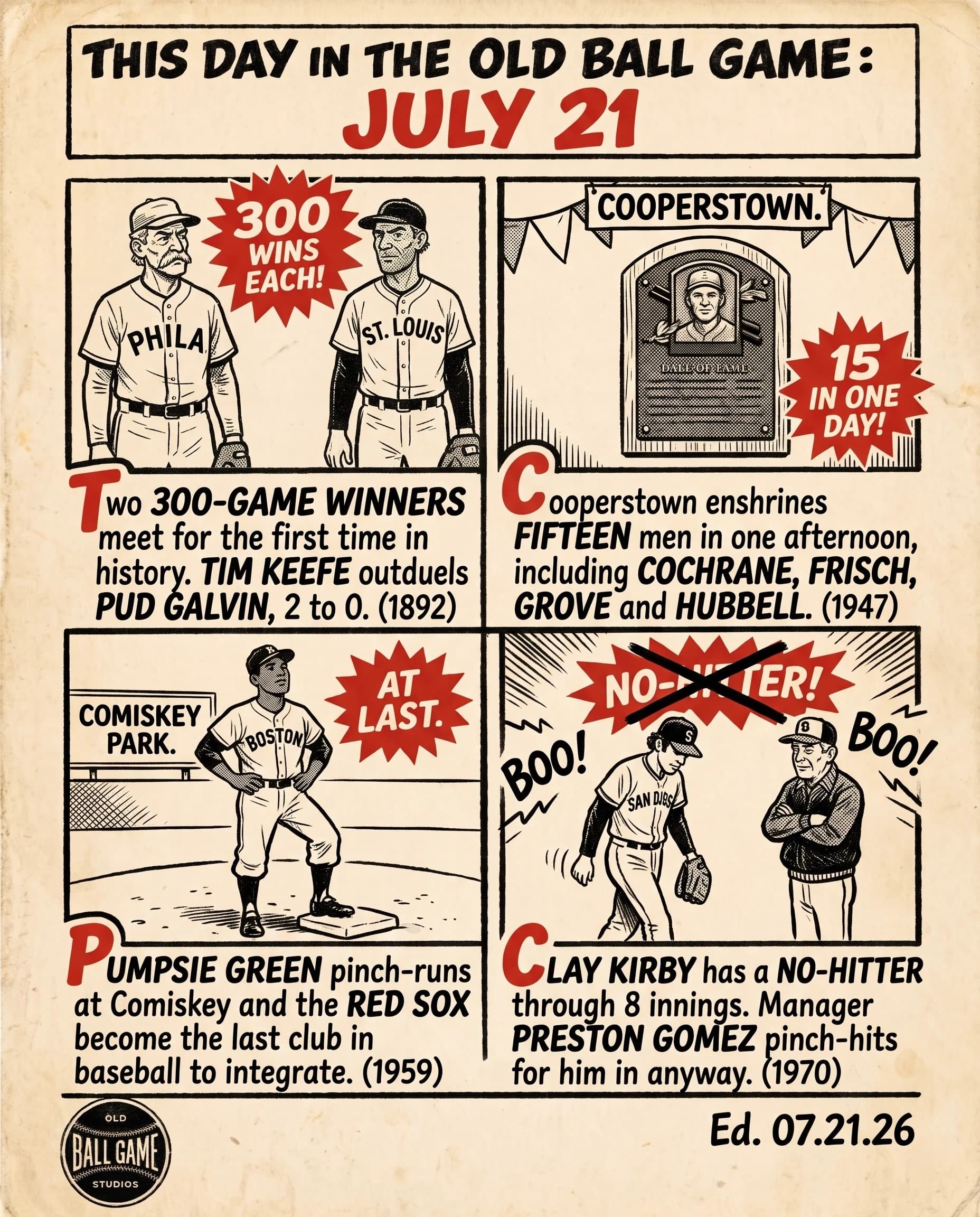
Two Immortals, One Afternoon (1892)
Only four pitchers had ever won 300 games, and on this day two of them stood at opposite ends of the same Philadelphia ballpark. Pud Galvin, the first man to reach the mark, pitched for the St. Louis Browns. Tim Keefe, the second, answered for the Phillies. Both were nearly done. Keefe won it 2 to 0. It was the first time two 300-game winners ever started against each other, and almost nobody in the park knew it.
Cooperstown Runs Out of Chairs (1947)
The war years had scrambled the calendar, so the classes of 1946 and 1947 went in together, fifteen men in one afternoon with Ford Frick presiding. The 1947 group was pure star power: Mickey Cochrane and Lefty Grove from Connie Mack's Philadelphia teams, Frankie Frisch and screwball artist Carl Hubbell from the Giants. Of the eleven men in the 1946 class, only Ed Walsh was there to hear his name read.
Twelve Years After Jackie (1959)
Boston was the holdout. A dozen years after Jackie Robinson, the Red Sox were the last of the sixteen clubs without a Black player. At Comiskey Park, down a run in the eighth, manager Billy Jurges sent Elijah "Pumpsie" Green in to run for Vic Wertz. Green never got past first. He stayed in at shortstop, Boston lost 2 to 1, and the color line was finally gone. The next morning the Globe ran four stories about Green and one about the ballgame.
Playing for the Win (1970)
Clay Kirby had not allowed a hit through eight against the Mets, but he walked the leadoff man in the first and watched him come around on two steals and a ground out, so San Diego trailed 1 to 0. With two outs in the eighth, Preston Gomez sent Cito Gaston up to hit for him. All 10,373 fans booed themselves hoarse. Gaston struck out, the bullpen gave up two in the ninth, and the Padres lost 3 to 0. Gomez never blinked. "I play this game to win," he said. San Diego waited until 2021 for its first no-hitter.